Psychopop Shenanigans
& Lurking Death
How the music of Danganronpa was made.
This Is Danganronpa
If you ask Kazutaka Kodaka, writer and creator of Danganronpa, why the blood in his series is depicted as bright pink, he’ll tell you it’s a creative choice.
You see, Danganronpa is not quite a horror game, and Kodaka knows that. In his words;
“If you try to make a horror game, you're not going to beat Dead Space, so why try? Rather than that, why not create your own new genre? I call it "psychopop." And if it's your own genre, there's no one to compete against, so you're automatically at the top! The idea of "psychopop" is that things are gruesome and horrific, but there's this pop twist to it: the visual flair. The reason why Danganronpa's blood isn't red is because of "psychopop" itself.”1Danganronpa director Kazutaka Kodaka on the power of “Psychopop.”
USgamer.net.
Now, this is probably not entirely true. Before it was Danganronpa: Trigger Happy Havoc, it was a prototype called DISTRUST. It was a darker, grittier thing, that focused on the relations you built with your fellow captives, and would have branching paths with alternate endings.2【まり探】始まりはアドベンチャーの否定から――CEDECで『ダンガンロンパ』開発陣が語る - 電撃オンライン.
Dengekionline.com.
While the branching paths were cut, and the final product dropped the grittier elements, it was still built on the idea of a ‘Psychopop Highschool Murder Mystery.’3Actually, back then, the term he used was ‘psychoshock,’ but same difference.
So, when Kodaka says, the blood is pink because of ‘psychopop,’ a part of me does believe him.
The other part of me has read an interview in which the producers from Spike Chunsoft are asked the same question, and they say that the blood was pink to lower the game’s rating as much as they could.4Nutt, C. (2021). Dangan Ronpa : Death, stress, and standing out from the crowd.
Gamasutra.com.
I choose to believe these reasons coexist. You might call it cope, but I call it nuance.
For what it's worth, I don’t believe Danganronpa works with red blood anyway. Whatever the reasons, Kodaka is right when he says Danganronpa is psychopop. It’s weird and unsettling, but there’s this pop feeling to it, this swagger, almost. It tells this story about the depths of despair, through the lens of loud, extreme stereotypes and a cheeky monochromatic mascot.
If you ask Masafumi Takada, composer for the series, about the music he’s made, he’ll say something very similar. Quote;
“I’ve spent the last ten years trying to establish Danganronpa as its own franchise.”
That line comes from a 2017 VGMO interview5Kotowski, D. (2017, November 15). Masafumi Takada and Kazutaka Kodaka: Discussion (HEAT UP!).
VGMO - Video Game Music Online. he did alongside Kodaka, who added;
“The music makes the games. Hearing the soundtrack makes me think, ‘Yeah, this is Danganronpa.’”
And if you’ve ever heard any of the songs from any of the games across the franchise, you’ll know exactly what he’s talking about.
Yeah. This is Danganronpa.
from Danganronpa: Trigger Happy Havoc
Make It Real
As far as I can tell, Takada and Kodaka work well together. Logistically, their process is very simple. Kodaka requests a song, gives Takada a general direction, and Takada makes the song.
Of course, I’m simplifying, but not by much, believe it or not. As he composes, Takada does engage with the developing story, he reads plot summaries to get a feel for the mood he’s trying to capture; but to hear him tell it:
“It’s easier than you’d think for me to write music that matches the game world. When I see a plot outline and designs I can hear the music in my head, so all I have to do is make it real.”
“All I have to do is make it real.”
I won’t lie to you. As someone who likes making music, I am immensely jealous.
Danganronpa: Trigger Happy Havoc
When getting started on composing the main theme for the first game, Takada recalls Kodaka asking for something ‘punchy,’ so he took that and tried to capture the energy from the project pitch. Apparently, he was also busy with other projects at the time, so he arranged it in about twenty or thirty minutes.
Very jealous.
As he was wrapping up, seemingly on a whim, he had his Mac’s built-in text to speech voice read out the game’s title, and he got goosebumps. Hence the iconic track we have today.
Despite how naturally it comes to him, creating songs that fit a mood is something that’s really important to Takada, and it’s a responsibility he takes very seriously. When composing, there’s always a specific feeling he wants to convey to the player.
For the exploration track, Beautiful Death, the feeling he wants to get across is “big things are afoot.” It opens with long sweeping strings, accompanied by synths, and then Takada’s iconic percussion kicks in. The piano scores your search of Hope’s Peak, alongside the sweeping synthesizers.
The feeling the class trial songs convey is ‘momentum.’ These sections are some of the most memorable in the game, and are entirely voice acted, so Takada focused on punchy, clear rhythms that work with the voice lines. He likens it to the background music in a racing game. Both the gameplay and music work together to give the player the feeling of momentum.
A highlight of the series are the various tracks that accompany the investigations sections. In this first game, Box 156Box 15 is personally my favorite track from Trigger Happy Havoc's soundtrack. stands out as notably jazzier than the rest of the soundtrack, with walking bass lines, swinging electric piano chords, and not to mention that sick trumpet solo, but still fits right in. This track makes the player feel like a detective. You’ve got work to do and evidence to find, so get out there and find it.
And, of course, the star of the show, Monokuma himself. The direction Kodaka gave for the mascot was, “hijinks,” and Takada delivered. Mr. Monokuma’s Lesson is built around vocals from a traditional African song7The actual chant is "O'She Baba," which translates to "Thank you, God," or "Thank you, Father.", and the trumpets and percussion that Takada adds elevate the sample into something that really shines when juxtaposed with Monokuma himself, adding up to be greater than the sum of their parts. When asked directly what he wanted to convey with the Monokuma songs, Takada said:
“Psychopop shenanigans and lurking death. Something like, ‘We’re all gonna die sooner or later, cha-cha-cha!’”
There’s that word again, and this time, it was Takada that used it. It highlights something that I noticed while doing research for this. Takada and Kodaka are creatives cut from the same cloth, a match made in psychopop heaven.
from Danganronpa: Trigger Happy Havoc
Danganronpa 2: Goodbye Despair
Takada takes an annual vacation to Hawaii, so when Kodaka asked for a new ‘tropical’ soundtrack, to fit the island setting of the sequel, it wasn’t a tall order.
“I had Kodaka-san’s request for a “tropical feel” as my base. From there, I wanted to emphasize the freedom of being under the open sky as opposed to being trapped in a building like the first game. Danganronpa 1 uses rather abrupt melodies to create a claustrophobic atmosphere. With Danganronpa 2, on the other hand, I wanted the player to feel that abundance of space.”
You hear this most explicitly in the exploration track Beautiful Ruin. Gone are the unsettling tones from the first game. The song’s melody is warm and unhurried, accompanied by steel pans, which eventually take over briefly as the central instrument. All the while, there are still the drums in the background, reminding you that this is still Danganronpa.
There’s no shortage of personality across the rest of the soundtrack, either. Monokuma gets a foil in this game, the generally unreliable Monomi. For her, Kodaka’s direction was, “make her sound like a mascot worthy of your pity.”
As it happens, the character wasn’t set in stone when Takada arranged her theme. As he recalls;
“…for Monomi’s theme, ‘Ms. Monomi’s Practice Lesson,’ I wanted to play with the fact that she’s been converted into a partial cyborg. The character wasn’t set in stone when I wrote the song, so I like to think that Monomi developed to match her music.”
To include the cyborg detail in the song, Takada has a computerized voice spell out M-O-N-O-M-I to the beat. In contrast to the traditional African chant from Monokuma’s theme, Monomi’s synth-heavy theme is punctuated by modern ‘Hey!’s and ‘Yeah!’s and ‘Yes!’s. And again it sums up the character, perfectly conveying the idea that she’s a counter to Monokuma.
Continuing the theme of banger investigation tracks, one of the most memorable songs from Danganronpa 2, in my opinion, is Kill Command. This plays in the latter half of the game, as the story approaches its climax. It’s this heavy metal thing, with loud rock guitar riffs that quote motifs from other songs across the soundtrack. Takada wrote it with his friend Jun Fukuda in mind, a fellow composer he’s worked with a few times.8Fukuda has worked with Takada on things like Smash Bros. and Resident Evil: The Umbrella Chronicles. He was also a sound designer on Lollipop Chainsaw and World's End Club. Fukuda supplied some of the energetic riffs from the song.
Before I move on to the next game, there’s one more song worth an honorable mention.
About halfway through the game, one of the characters, Ibuki Mioda, Ultimate Musician and punk rocker extraordinaire, performs a song. It’s titled ‘From Me to You Too,’ but don’t let that romantic title fool you. Here are some of the lines;
I sent you a threatening letter
And added "I LOVE YOU" in invisible ink
But it doesn't reach you.
The straw doll I prepared in the hour of the Ox
Is looking at me, laughing
Cackling, cackling, cackling and laughing.
I thrust a spike into its chest
A hammer in my hand, and bang bang bang
Serves you right! Bang bang bang!
Performed by Koshimizu Ami, Ibuki’s Japanese VA, it’s truly a love song for the ages. Not to mention actually listening to the thing. It’s based on a Japanese ghost story9Ibuki's song is based on a folktale called Ushi no Koku Mairi – Shrine Visit at the Hour of the Ox.., and honestly, basing a love song on a horror story is exactly the type of thing Ibuki would do.
Danganronpa Another Episode: Ultra Despair Girls
The spinoff is decidedly different from the rest of the franchise. There are still visual novel elements here, before that, Ultra Despair Girls is an action-adventure, third-person shooter. It’s different, but still Danganronpa, and that’s apparent from the second you open it and the game’s theme begins groovin’.
Having worked with Takada for years now, Kodaka’s directions are growing increasingly vague, and for this title, he recalls asking for “an 80’s electro sound,” and true to form, this game’s soundscape is steeped in synth. Kodaka will point out the Monoku-Man arcade theme, Monoc-Man10It's a Monokuma World. Disc 1, Track 7., as a realization of this idea, and he’s not wrong. It’s full of drones and synth arps and sawtooths, but I’d sooner point to the main theme.
Ultra? Despair? Girls?, the song you first hear when you open the game, is an unrepentant bop.11It's very close, but this is my favorite song in the franchise. Take everything that made Miss Monomi’s Practice Lesson a joy to listen to, and crank it up to eleven. With high energy vocals, a groovy, rhythmic sawtooth synth, and a drum and bass throughline that makes you wanna move, it does a wonderful job at setting the stage for the weird experience that is playing through the Danganronpa spinoff title, and to me, it is the epitome of what ‘psychopop’ sounds like.
When asked about his favorite track from the game, Takada said;
“My favorite track is probably ‘Ghost Stories From the School District of Revolution12Legend of the Revolution. Disc 2, Track 2.,’ it really encompasses the feel of the game.”
His pick is entirely valid, but is a noticeably less high energy song than Kodaka’s or my pick, and for that reason, he’s probably right. Ultra Despair Girls is a very weird game13There's a collectible note you can find in-game that is UDG in a nutshell. I've linked it in the footnotes. You have been warned., and ‘Ghost Stories From the School District of Revolution,’ captures that feeling perfectly. But more than that, he recalls going the extra mile to make this song, to make it match what he heard in his head. The quote continues;
“I wanted to use a synth sound in the bridge section but it wasn’t happening with my new setup so I had to pull out my old Mac to do the recording. I could have used a different sound, but I knew what I wanted so I stuck to my guns even though I really didn’t have time to be so picky.”
Making music that matches the game feel is something that’s really important to Takada. It comes across in this game especially. Despite this being a Danganronpa game, the established motifs are nowhere to be heard in the game’s main songs.
Takada felt that the game’s soundtrack would’ve sounded plain if he relied on using established melodies, and so he promised himself he wouldn’t. Later, he admits that he likely made it harder on himself than he needed to, but succeeded in making songs that maintained the tone of Danganronpa without using old motifs and melodies.
from Danganronpa Another Episode: Ultra Despair Girls
Danganronpa V3: Killing Harmony
Takada was working with all-new equipment in a new studio, and a new direction for the third main game in the series. This time around, Kodaka wanted something more adult, something a little more stylish than pop, so Takada leaned heavy into jazz. Like with Ultra Despair Girls, this new sound for the game is apparent from the start.
The opening theme, DANGANRONPA V3, is a spiffy jazz reimagining of the classic theme, swapping out the usual breakbeat percussion and synths for an acoustic drumset, saxophones, the funky Rhodes and accompanying guitars. The haunting choir section also makes a return, sounding just as good with the jazz background.
Across the rest of the soundtrack, this jazzier feel, blended with the franchise’s sampled breakbeat roots. True to form, the exploration tracks, especially Beautiful Lie, are a microcosm of this idea. It also happens to be one of Takada’s personal favorites;
“I’m fond of [it]. I’m happiest when I’m making this sort of track.”
It burns itself into your brain without being annoying, something that Takada sets out to do with exploration tracks, and if I’m being honest, I’m running out of ways to describe why these songs are so good without just repeating myself. In this game, the cast is restricted to a school building, like in Danganronpa 1, but you can wander around under the ‘sky,’ like in Danganronpa 2, so this song strikes a nice middle ground between claustrophobia and freedom. Not quite caged, not quite free.
As for the investigation tracks, this game boasts the best ones in the franchise. Despair Searching14This is my second favorite Danganronpa track. runs with the idea of making the player feel like a detective—which is apt, considering you follow Shuichi Saihara, Ultimate Detective, through most of the game. Over breakbeat drums, and soft synths, a trumpet solo brings the whole thing together. And later Hope Searching, the climactic version of the track, throws in a rock guitar that belts out loud, proud riffs as the player closes out the story.
The Danganronpa V3 soundtrack is a culmination of everything that makes Danganronpa sound like Danganronpa. There are over a hundred songs in here, and it’s split into WHITE & BLACK.
“Simply put, there was too much music for one album! If you like the class trial music and other tracks like it, you’re safe with just the BLACK album. If that leaves you hungry for more, pick up the WHITE album!”
Takada also goes on to say that, in his effort to make the sound of Danganronpa its own genre, he has plenty of unused material, which honestly makes me shudder. Almost three hundred and fifty songs across four games and still, he feels like there’s plenty left on the cutting room floor.
What I wouldn’t give to hear what was left behind.
Before I move on to the next section, and get into what Takada has been up to since the release of the last Danganronpa game, I’d like to give a massive thanks to the VGMO interview I mentioned earlier. It’s my source for a lot of what you’ve just read, and a wonderful window into the making of the music of these unique, weird, wonderful games. If you’d like to give it a read, an archived version is linked here, and in the footnotes at the bottom of the page.
from Danganronpa V3: Killing Harmony
Danganronpa and Beyond
In 2017, after the release of Danganronpa V3, Kodaka was beginning to play with the idea of starting a development company of his own. This idea grew into what is now Too Kyo Games, and its founding members are Kodaka, Takada, Rui Komatsuzaki (artist for the Danganronpa games) and Kotaro Uchikoshi, director and writer of the Zero Escape series.
Fun fact, the company was actually started by Takada himself, not Kodaka. As the story goes, the four were out for drinks, and Kodaka had mentioned the idea of going independent to them, but nothing about actually starting a company.15ファミ通.com. (2018, September 11). 小高和剛氏、打越鋼太郎氏らによる新会社Too Kyo Games設立! 日本独自のゲームで世界に挑む、新会社設立に迫るインタビュー.
ファミ通.com. At the time, he’d felt like it wasn’t going to go anywhere for at least two or three years, but the general atmosphere was in the air.
When it did start, it felt informal; in Kodaka’s words;
“Even after we actually established the company, it felt more like a club activity than a business. So, I relied on Takada.”
Takada was the only one of the four who actually had experience with the business side of things; he has his own label, Sound Prestige16soundprestige.jp, through which he’s released the music he’s worked on, including the Danganronpa soundtracks. Of starting Too Kyo, he said;
“I had already started my own company and had been involved in the launch of various other companies, so I had the know-how regarding businesses. That’s why I decided to start my own company. So, actually, I established the company [in 2017], and everyone else joined later.”
Too Kyo Games (translates roughly to Too Crazy Games, which… is fitting), went on to develop The Hundred Line: Last Defense Academy, an ambitious title co-written by Kodaka and Uchikoshi that boasts a hundred endings. The company also developed Master Detective Archives: Rain Code, World’s End Club, and more.
Danganronpa isn’t quite over yet. Co-developed with Gemdrops, Too Kyo Games is working on a remake and reimagining of the second title, and Danganronpa 2x2 is set for release later this year. It’ll feature both the revamped original scenario and an all-new scenario told with the same characters.
It’s written by Danganronpa veteran and Too Kyo member Yoichiro Koizumi, novelist behind Ultra Despair Hagakure and co-writer on the Danganronpa anime and various other Danganronpa projects. Kodaka remains on as a scenario supervisor, Komatsuzaki returns as artist, and once again, aided by Jun Fukuda, Takada returns as composer.
Despite how weird the game’s stories have gotten in the past, I’d be lying if I said I wasn’t excited to play through the new game when it comes out.
I’ll leave you with a quote from Takada, one that sums up his approach to composing. This comes from an interview he did with AUTOMATON Japan17Ayuo Kawase (20216, January 16).『ハンドレッドライン』の作曲家・高田雅史氏に、曲について“いっぱい”解説してもらった。「あれがあれに似ていますが」「あのボーカル曲なぜ採用」「SIREIのBGMは……何?
Automaton-Media.com., following the release of The Hundred Line:
“When you look at game reviews, you sometimes see comments like ‘the music was great,’ and that’s not really praise for the music, it means the music stands out more than the game itself. In other words, it’s not that a cohesive game is being made; it’s that the playing experience and the music are out of sync. I want people to think about it that way. That’s why, when I make music, I’m always considering these things to make the entire game experience entertaining.”
-
WIP
As of March 16th, I haven't finished working on all of the music for this page yet.
Please be patient with me, I'm not quite at Takada's level yet. - 1 Mackey, B. (2015, December 28). Danganronpa director Kazutaka Kodaka on the power of “Psychopop.” USgamer.net. ↩
- 2 【まり探】始まりはアドベンチャーの否定から――CEDECで『ダンガンロンパ』開発陣が語る - 電撃オンライン. Dengekionline.com. ↩
- 3 Actually, back then, the term he used was ‘psychoshock,’ but same difference.↩
- 4 Nutt, C. (2021). Dangan Ronpa : Death, stress, and standing out from the crowd. Gamasutra.com. ↩
- 5 Kotowski, D. (2017, November 15). Masafumi Takada and Kazutaka Kodaka: Discussion (HEAT UP!). VGMO - Video Game Music Online. ↩
- 6 Box 15 is personally my favorite track from Trigger Happy Havoc's soundtrack.↩
- 7 The actual chant is "O'She Baba," which translates to "Thank you, God," or "Thank you, Father."↩
- 8 Fukuda has worked with Takada on things like Smash Bros. and Resident Evil: The Umbrella Chronicles. He was also a sound designer on Lollipop Chainsaw and World's End Club.↩
- 9 Ibuki's song is based on a folktale called Ushi no Koku Mairi – Shrine Visit at the Hour of the Ox..↩
- 10 It's a Monokuma World. Disc 1, Track 7.↩
- 11 It's very close, but this is my favorite song in the franchise.↩
- 12 Legend of the Revolution. Disc 2, Track 2.↩
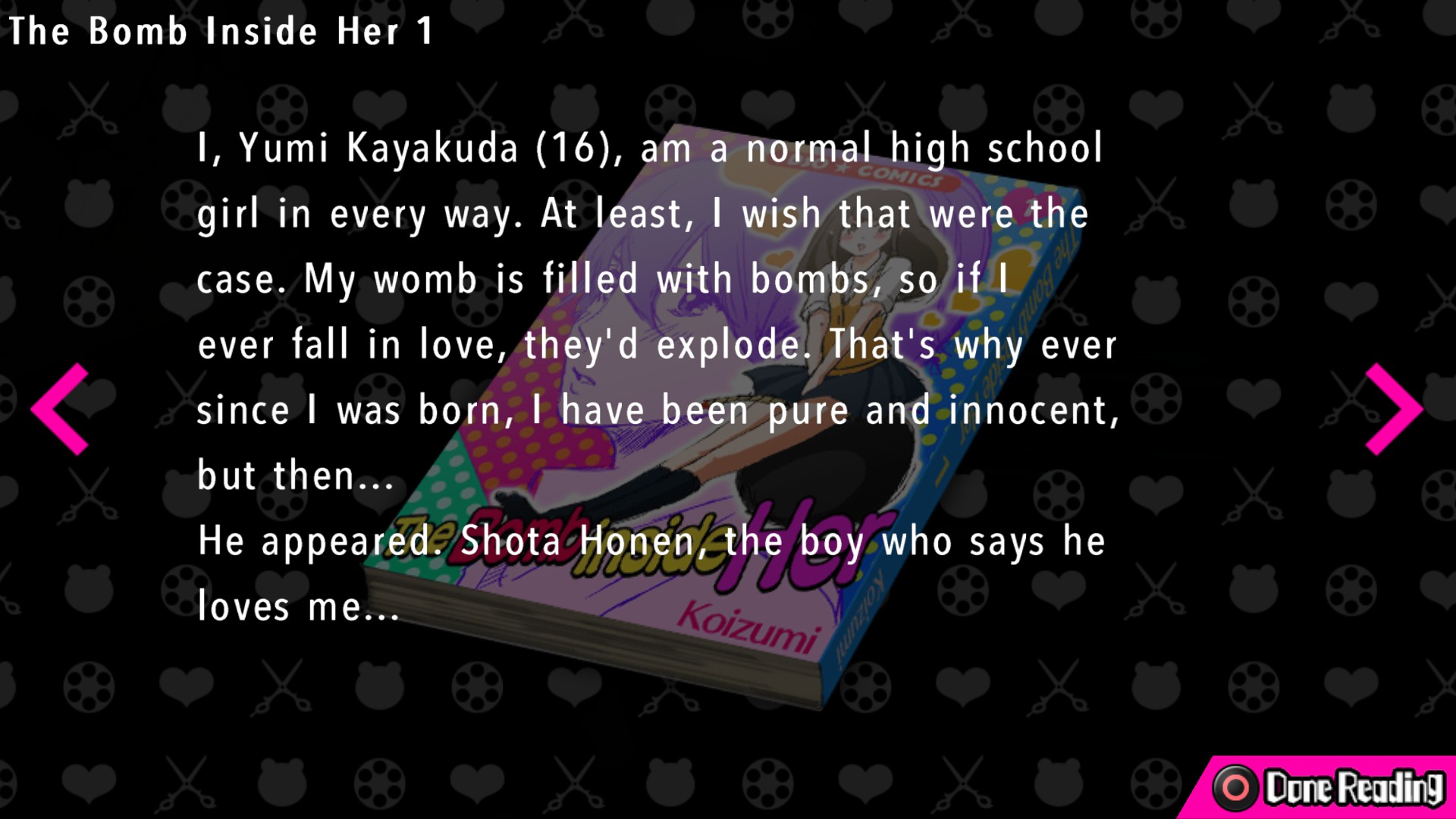
- 13 There's a collectible note you can find in-game that is UDG in a nutshell. It's a fictional manga that exists within the game world. View image at your own peril.↩
- 14 This is my second favorite Danganronpa track.↩
- 15 ファミ通.com. (2018, September 11). 小高和剛氏、打越鋼太郎氏らによる新会社Too Kyo Games設立! 日本独自のゲームで世界に挑む、新会社設立に迫るインタビュー.ファミ通.com. ↩
- 16 Sound Prestige ↩
- 17 Ayuo Kawase (20216, January 16).『ハンドレッドライン』の作曲家・高田雅史氏に、曲について“いっぱい”解説してもらった。「あれがあれに似ていますが」「あのボーカル曲なぜ採用」「SIREIのBGMは……何?Automaton-Media.com. ↩